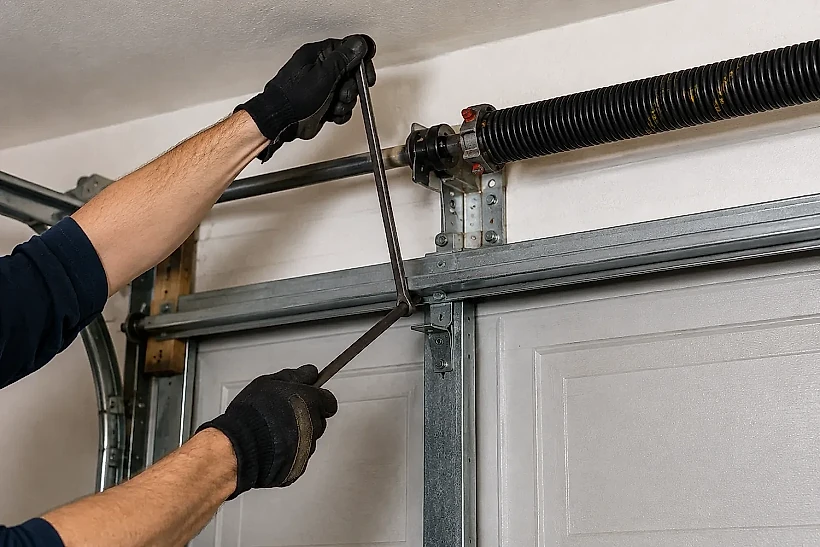
How to tell it is the spring
You usually do not need to guess. A broken torsion spring announces itself, and the signs line up:
- A bang. Most people describe it as a gunshot or a firecracker inside the garage, often at night or first thing in the morning. That is the sound of several hundred pounds of stored tension letting go.
- A gap in the coil. Look at the spring on the shaft above the door. A healthy spring is one continuous coil. A broken one has a two- to three-inch gap somewhere along its length.
- Loose cables. The lift cables on each side of the door go slack, kink, or hang off the drum, because the spring was what kept them under tension.
- The door is suddenly heavy. The opener lifts it six inches and stops, or strains and reverses. By hand it feels like the 200-pound object it is, because the spring was carrying that weight.
- The door hangs crooked if one side dropped further than the other.
- The top panel bows when the opener tries to pull a door that will not follow.
Extension springs, the long ones that run beside the horizontal tracks on older or lighter doors, break too. The signs are the same, minus the gap in the coil, and you may see the broken spring hanging on its safety cable.
Why you leave it alone
A torsion spring is wound to hold the full weight of the door in balance. Even broken, the remaining spring on a two-spring door is still under load, and the broken one can still have tension trapped in it. Unwinding, removing or fitting one without winding bars and the right technique is how people lose fingers. The opener is no help either: it was sized to guide a balanced door, and asking it to lift 200 pounds bends the top section, strips the drive gear, or both. And the manual release cord, which is so useful on a healthy door, is dangerous on this one, because a door with no spring drops the moment it is disconnected from the opener.
Do not press the opener button again. Do not pull the red release cord if the door is open. Do not try to lift a double door with a helper. Do not touch the spring, the cables, the drums or the set screws on the shaft. Do not order a spring online and fit it yourself.
What to do right now
- Leave the door where it is. Down is best. Partly open is worse but survivable: keep everyone away from the opening.
- Unplug the opener so nobody in the house presses a remote out of habit.
- Keep cars and people out from under it. If it is open and there is a car underneath, do not move the car until we have secured the door, unless you can do it without being under the door.
- If the door is open and the house is exposed, close the door from the garage into the house and lock it. The garage door itself can wait until we get there.
- Call. (224) 395-0939. Say "broken spring" and whether a car is stuck; both change how fast we route someone to you.
If your car is inside
This is the call we prioritize. A small single door with one spring can sometimes be lifted by two adults enough to back a car out, but it can drop the instant a grip slips, and we have seen hoods, roofs and hands pay for it. Our honest advice is to book a rideshare for the morning commute and let us open the door properly. Spring calls with a trapped car are usually on our board first, and the after-hours line exists for the evening version of this problem.
What the repair involves
The technician arrives with the common torsion and extension sizes on the van. The job runs like this:
- The door is secured and disconnected from the opener.
- The door is weighed, and the old springs are measured for wire size, inside diameter and length. Springs are matched to the door's actual weight, not the size printed on a sticker from 2004.
- Both springs come off and a matched pair goes on. On a two-spring door we replace both every time, because the second one has the same cycles on it and will fail within months.
- The cables, drums and bearing plates are inspected. A snapping spring often takes the cables with it; frayed ones are replaced on the same visit.
- The springs are wound to the manufacturer's turn count with winding bars, then the door is balance-tested by hand at three heights. It should stay wherever it is left.
- The opener is reconnected, its force limits reset to the now lighter door, and the safety reversal tested.
Sixty to ninety minutes on most residential doors, and the door is back in use when we leave.
What it costs
Spring replacement is $350 to $750 for a matched pair, installed, and you get the exact number in writing before any work starts. The range depends on the door's size and weight, torsion versus extension, and whether cables, drums or bearings need to go with the springs. If the cables are frayed we replace them on the same visit; as a standalone job, cable replacement runs $450 to $550. The work carries our two-year warranty on the installation, and the springs themselves carry the manufacturer's warranty. The full breakdown is in our spring replacement cost guide.
Why it broke, and how to get more years out of the next one
Springs wear out by counting. A standard spring is rated around 10,000 cycles, which is seven to twelve years for a typical family and a lot less for a household that uses the garage as the front door. Rust from road salt, a spring that was slightly undersized for the door, and dry coils that never saw lubricant all shorten that. Cold finishes off the ones that are close, which is why our spring calls spike on the first hard freeze; there is more on that in why garage doors fail in the cold.
If the door cycles many times a day, ask about a high-cycle set rated for 20,000 cycles or more. It costs a little extra on the day and can double the time before you hear that bang again. And a yearly $100 tune-up, which lubricates the coils and checks balance and wear, is the cheapest insurance the door can have.